Operating profit near a record high, yet net income down about 25% year over year—that is the awkward close to Create Corporation’s (3024) fiscal year ended March 2026.
Revenue rose to ¥37.32bn, while operating profit of ¥0.823bn and ordinary profit of ¥0.786bn both increased. Net income, however, landed at only ¥0.365bn after a ¥0.134bn impairment on the Kakogawa branch. Mid-term plan Vision110 was also effectively withdrawn, scaled from ¥44.0bn in revenue and ¥1.0bn in operating profit down to ¥40.0bn and ¥0.9bn.
For a 110-year-old regional piping-materials wholesaler pitching a shift from selling goods to selling materials-plus-labor services, the question is sharp: does that pivot change a thin-margin model, or does the housing-linked wholesale business simply continue? With a thin net-cash cushion, the numbers need separating.
A piping wholesaler stretching into construction
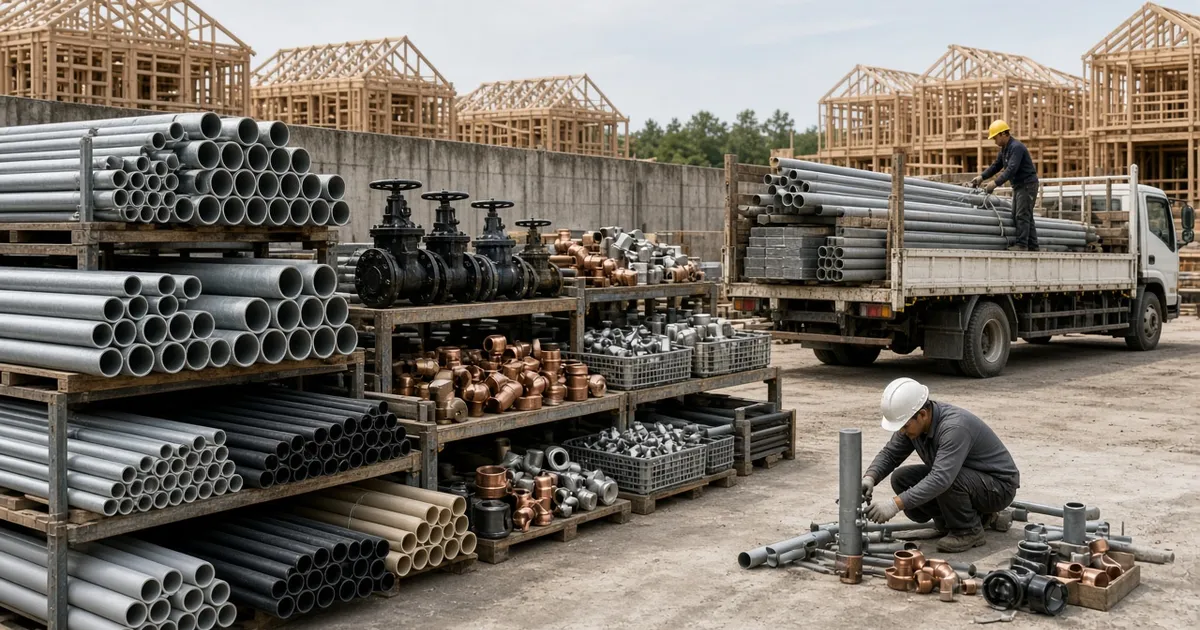
Create’s core business is selling piping materials—pipes, fittings, valves, and related housing equipment. Categories include drainage/sewage, hot- and cold-water supply, chemical products, and other (including air-conditioning and housing equipment). Roughly 60% of sales track housing demand. The group includes manufacturer Daidore (Toro-brand drainage fittings and related products), processor Daipoly System, construction affiliate Critec, and hauler Haneishi. Reliable supply and dense local coverage are the practical differentiators.
Management highlights logistics reorganization such as the Tokai distribution center (about 2,500 tsubo, opened September 2024), in-house brand manufacturing, and a push into materials-plus-labor orders after obtaining construction licenses. The construction-related segment, though, still posts only about ¥0.11bn in revenue and an operating loss—roughly 0.3% of sales. The story is ahead of the numbers.
Top-line growth and peak-cycle operating profit, then impairment
Start with the consolidated trajectory.
| Metric | 2024 | 2025 | 2026 |
|---|---|---|---|
| Revenue (¥bn) | 35.86 | 36.55 | 37.32 |
| Net income (¥bn) | 0.14 | 0.49 | 0.36 |
| Net profit margin | 0.4% | 1.3% | 1.0% |
Revenue rose for a third straight year, and FY2026 operating profit sat near a record. Chemical products (+5.1%) and other (+7.8%) led the mix, while drainage/sewage (−1.7%) and hot-/cold-water supply (−3.1%) still show housing starts weakness.
The net-income drop is mainly the Kakogawa impairment tied to land-value declines and a reassessment of future earnings. Read as a one-off, operating cash flow of about ¥1.04bn alongside debt repayment and another dividend hike points less to a collapse in earning power than to accounting profit being cut. The net profit margin, however, remains about 1.0%—still a classic thin wholesale margin.
Owner earnings value exceeds market value, but the margin of safety is limited
Beyond reported earnings, look at owner earnings.
(* Simulation assumptions: estimated share price 1,195 yen, required return 5%)
| Metric | 2024 | 2025 | 2026 |
|---|---|---|---|
| Owner earnings (¥bn) | 0.155 | 0.32 | 0.273 |
| Owner earnings value (¥bn) | 3.105 | 6.395 | 5.453 |
Owner earnings moved from ¥0.155bn to ¥0.32bn to ¥0.273bn. Capitalized at a 5% required return, owner earnings value is ¥5.453bn most recently. Versus an estimated market capitalization of about ¥4.657bn at the 1,195-yen simulation price, that leaves a modest cushion. A PBR near 0.8x also reads as growth expectations not being priced in.
That is not, by itself, a buy case. As long as thin margins and housing dependence persist, owner earnings themselves struggle to compound. The dividend is ¥40 (a fifth consecutive increase), with a consolidated payout ratio of 42.7%. Company guidance for FY2027 calls for ¥40.0bn in revenue, ¥0.90bn in operating profit, ¥0.55bn in net income, and a ¥43 dividend—but that comes right after Vision110 was scaled back, so miss risk remains.
Only ¥0.545bn of net cash—not a fortress balance sheet
For downside protection, check net cash.
| Metric | 2024 | 2025 | 2026 |
|---|---|---|---|
| Net cash (¥bn) | 0.691 | 0.924 | 0.545 |
| Net current asset ratio | 14.8% | 19.9% | 11.7% |
Net cash fell from ¥0.924bn to ¥0.545bn, and the net current asset ratio is 11.7%. That is only about 12% of estimated market cap—far from a cash-rich comfort story. Equity ratio of 30.4% and BPS of ¥1,429.24 help, but this remains a classic wholesale balance sheet funded by inventory, receivables, and payables. Rising merchandise inventory and trade payables have already trimmed net-cash headroom under our definition.
Housing decline and execution gap are the core risks
Three issues stand out.
First, about 60% of sales track housing demand. Structural declines in new housing starts already undercut Vision110 assumptions, and IR materials mention a path toward roughly 700,000 starts in the 2030s. Second, the materials-plus-labor execution gap: the construction segment is still tiny and loss-making, and the company itself cites shortages of construction-management talent and know-how. Third, thin industry margins plus customer-base risk as larger trading houses consolidate via M&A. Delayed internal DX is also flagged as a priority issue.
There are constructive readings too. Revenue and near-record operating profit held up despite weaker starts, suggesting price pass-through and mix (chemicals and other) absorbed some demand loss. If Daidore manufacturing and the materials-plus-labor shift show up in construction revenue and gross margin, the thin-margin structure could change. That remains a hypothesis, not a fact.
Investor takeaway: wait for construction numbers
The current stance is wait / pass for now. Two reasons: ¥0.545bn of net cash cannot underwrite a downside story, so any value case leans too hard on a simple owner-earnings comparison; and evidence that materials-plus-labor changes earning power—construction revenue and a segment profit turn—is still negligible.
Monitoring triggers from here:
Bullish monitoring triggers:
- Construction (materials-plus-labor) revenue and segment profit expand in quarterly and full-year disclosures and move toward breakeven or black
- Operating margin excluding impairment and similar items holds in the high-2% range or improves even as housing starts stay soft
Warning / pass monitoring triggers:
- Accelerating declines in housing-linked categories (drainage, hot-/cold-water) with shrinking revenue and gross profit, and operating profit peaking out in disclosures
- Further erosion of net cash from inventory and payable bloat, with balance-sheet and cash-flow signs that debt repayment and dividends become hard to run in parallel
This is not a name to buy on a 110-year wholesaler brand alone. Operating capability is visible; the mid-term pullback and thin cushion say waiting for real materials-plus-labor proof is the more rational stance.
Want to simulate the "fair value" of CREATE CORPORATION?
Interested in digging deeper into the financial data for CREATE CORPORATION featured in this article?
At okuriru.com, you can run simulations for CREATE CORPORATION based on Buffett-style "owner earnings." Enter your required rate of return (hurdle rate) to instantly calculate a theoretical stock price.
👉 Calculate CREATE CORPORATION's theoretical stock price
Resolve the question "Is this stock fairly priced?" using your own criteria. CSV downloads of financial data are available too!